
- northflank.com
Cloud Hypervisor vs gVisor
Cloud Hypervisor and gVisor both contribute to the same goal: running workloads with stronger isolation than standard containers provide. They take fundamentally different approaches to get there, and…
- northflank.com
Enterprise vibe coding: how to deploy AI-generated apps safely
## TL;DR: enterprise vibe coding deployment - Enterprise vibe coding requires the same deployment controls as any production application: secrets management, scoped database credentials, environment i…
- Featurenorthflank.com
January & February 2026 | Product releases
Northflank rebuilt its metrics system with collapsible categories, per-pod breakdowns, and GPU visibility, while adding static egress IPs and dedicated load balancers for networking. Workload identiti…

- Featurenorthflank.com
March & April 2026 | Changelog
Northflank introduced significant performance optimizations for large teams, including on-demand resource fetching and paginated UI. Cross-project build services and advanced template features like te…

- Contentnorthflank.com
Best CI/CD tools in 2026
## TL;DR: What are the best CI/CD tools in 2026? CI/CD (continuous integration and continuous delivery) tools automate the build, test, and deployment stages of the software delivery pipeline. Here ar…
- northflank.com
Kata Containers vs gVisor
Kata Containers and gVisor both address the shared-kernel problem that standard containers leave unsolved. They take different architectural approaches, make different tradeoffs on isolation strength …
- northflank.com
Best enterprise-safe platforms for running and hosting AI apps in 2026
> *Enterprise-safe deployment for AI apps means more than a live URL. It means compliance certifications that cover your deployment model, execution isolation for AI-generated code, data that never le…
- Contentnorthflank.com
MicroVM vs gVisor
MicroVMs and gVisor both address the same fundamental problem: standard containers share the host kernel, and that shared kernel is the attack surface. The two technologies take different architectura…
- Featurenorthflank.com
How non-technical employees can build and ship internal apps with AI, securely
> Non-technical employees can now generate working internal apps from natural language descriptions using AI coding tools like Claude Code, Codex, Cursor, and many others. The code generation problem …
- northflank.com
Best GitHub Actions alternatives in 2026
## TL;DR: What are the best GitHub Actions alternatives in 2026? GitHub Actions is a CI/CD platform built into GitHub that uses YAML-based workflow syntax to automate builds, tests, and deployments. I…
- Contentnorthflank.com
Kata Containers vs Docker
Kata Containers and Docker both run containerised workloads, but they make fundamentally different tradeoffs around isolation, security, and operational complexity. Docker is the standard for cloud-na…
- northflank.com
10 best DigitalOcean alternatives in 2026
## TL;DR: What are the best DigitalOcean alternatives in 2026? Teams consider alternatives to DigitalOcean when they need stronger CI/CD tooling, more advanced Kubernetes features, multi-cloud flexibi…
- Contentnorthflank.com
What is continuous deployment?
## TL;DR: What is continuous deployment? - Continuous deployment is the practice of automatically releasing every code change that passes all pipeline quality gates directly to production, without man…
- Contentnorthflank.com
Best VMware alternatives in 2026
## TL;DR: What are the best VMware alternatives in 2026? Since Broadcom's acquisition of VMware in late 2023, organisations have been reassessing their virtualisation infrastructure. Perpetual licence…
- Contentnorthflank.com
How to deploy vibe-coded apps to production
You have a vibe-coded app that runs on localhost. Maybe you built it with Claude, Cursor, Lovable, or Bolt. It works. The question is where it actually runs in production and how you make sure it stay…
- Contentnorthflank.com
What are Kata Containers?
Kata Containers is an open-source container runtime that runs workloads inside lightweight virtual machines rather than standard containers, while integrating with the same container tooling engineers…
- Contentnorthflank.com
Best deployment platforms for vibe coders in 2026
Vibe coding tools have solved the code generation problem. You describe what you want, and Lovable, Bolt, Cursor, or Claude Code produces working application code in minutes. The problem most vibe cod…
- Featurenorthflank.com
Configure teardown workflows
Northflank introduced teardown workflows to automate cleanup of OpenTofu resources, preview environments, and workflows. Users can define cleanup tasks in the teardownSpec section, with options to des…
- Featurenorthflank.com
How to run untrusted code on Kubernetes safely
Running untrusted code on Kubernetes is not safe by default. Standard containers share the host kernel, which means a kernel vulnerability in one container can affect the host and every other workload…
- Featurenorthflank.com
Sandboxes on Kubernetes: isolation options and how to run them in production
Most enterprises already run Kubernetes. When they need to run AI agents that execute untrusted code, the question is not whether to use Kubernetes; it is how to add the isolation, lifecycle managemen…
- Contentnorthflank.com
KVM vs QEMU: key differences and how they work together
[KVM](https://northflank.com/blog/what-is-kvm) and QEMU are two of the most widely used open-source virtualisation technologies on Linux. If you have searched for the difference between them, you have…
- Contentnorthflank.com
What is KVM?
KVM, or Kernel-based Virtual Machine, is a virtualisation module built into the Linux kernel that lets a Linux host run multiple isolated virtual machines. It uses CPU hardware virtualisation extensio…
- Contentnorthflank.com
What is sandbox infrastructure? A guide for AI and engineering teams
## TL;DR: What is sandbox infrastructure? - **Sandbox infrastructure** is the full stack required to run isolated workloads safely at scale: isolation technology, orchestration, networking, secrets ma…
- northflank.com
What is gVisor?
gVisor is an open-source application kernel developed by Google that sandboxes containers by intercepting system calls in user space. It sits between your containerised workload and the host kernel, h…
- Contentnorthflank.com
What is a microVM?
A microVM is a lightweight virtual machine designed to run isolated workloads with minimal overhead. Unlike standard containers, each microVM runs its own Linux kernel enforced by hardware virtualisat…
- northflank.com
Firecracker vs Docker: key differences and when to use each
Docker containers and Firecracker VMs are both ways to run isolated workloads on shared hardware. But they solve different problems, make different security tradeoffs, and are designed for different t…
- Competitive Content Marketingnorthflank.com
LangSmith Sandboxes alternatives for secure AI code execution
## TL;DR: LangSmith Sandboxes alternatives for secure AI agent code execution - LangSmith Sandboxes launched in March 2026 and are currently in private preview, with waitlist-only access and APIs subj…
- Contentnorthflank.com
Containers vs virtual machines: key differences and when to use each (2026)
Containers and virtual machines are the two dominant approaches to running isolated workloads on shared hardware. Both package an application and its dependencies into a portable, isolated environment…
- northflank.com
6 best Railway alternatives in 2026: Pricing, flexibility & BYOC
> *“I just want my app to stay online without constantly worrying about credits or limitations.” ~ someone on [Reddit](https://www.reddit.com/r/programminghelp/comments/1hi11b3/looking_for_help_with_r…
- Launchnorthflank.com
Top internal developer portals in 2026
The article defines and compares internal developer portals and platforms, emphasizing the growing need for self-service infrastructure provisioning in 2026. It highlights that most teams initially se…
- Featurenorthflank.com
Top managed database services in 2026
The article compares the top managed database services in 2026, highlighting Northflank as a standout full-stack platform that supports multiple database engines (PostgreSQL, MySQL, MongoDB, Redis, et…
- northflank.com
Best European-based PaaS providers in 2026
European-based Platform-as-a-Service (PaaS) providers are increasingly critical for engineering teams requiring compliance with EU or UK data protection frameworks, as legal jurisdiction and data resi…
- Contentnorthflank.com
What is a customer deployment platform? A guide for developers and SaaS vendors
A customer deployment platform is a system designed to deploy and manage software in customer-controlled environments, either within a team’s own cloud infrastructure or a SaaS vendor’s customer’s clo…
- Launchnorthflank.com
What is a software distribution platform? A guide for SaaS vendors
A software distribution platform is a system that enables software vendors—particularly ISVs and SaaS companies with self-hosted offerings—to deliver, deploy, license, and manage their software in cus…
- Featurenorthflank.com
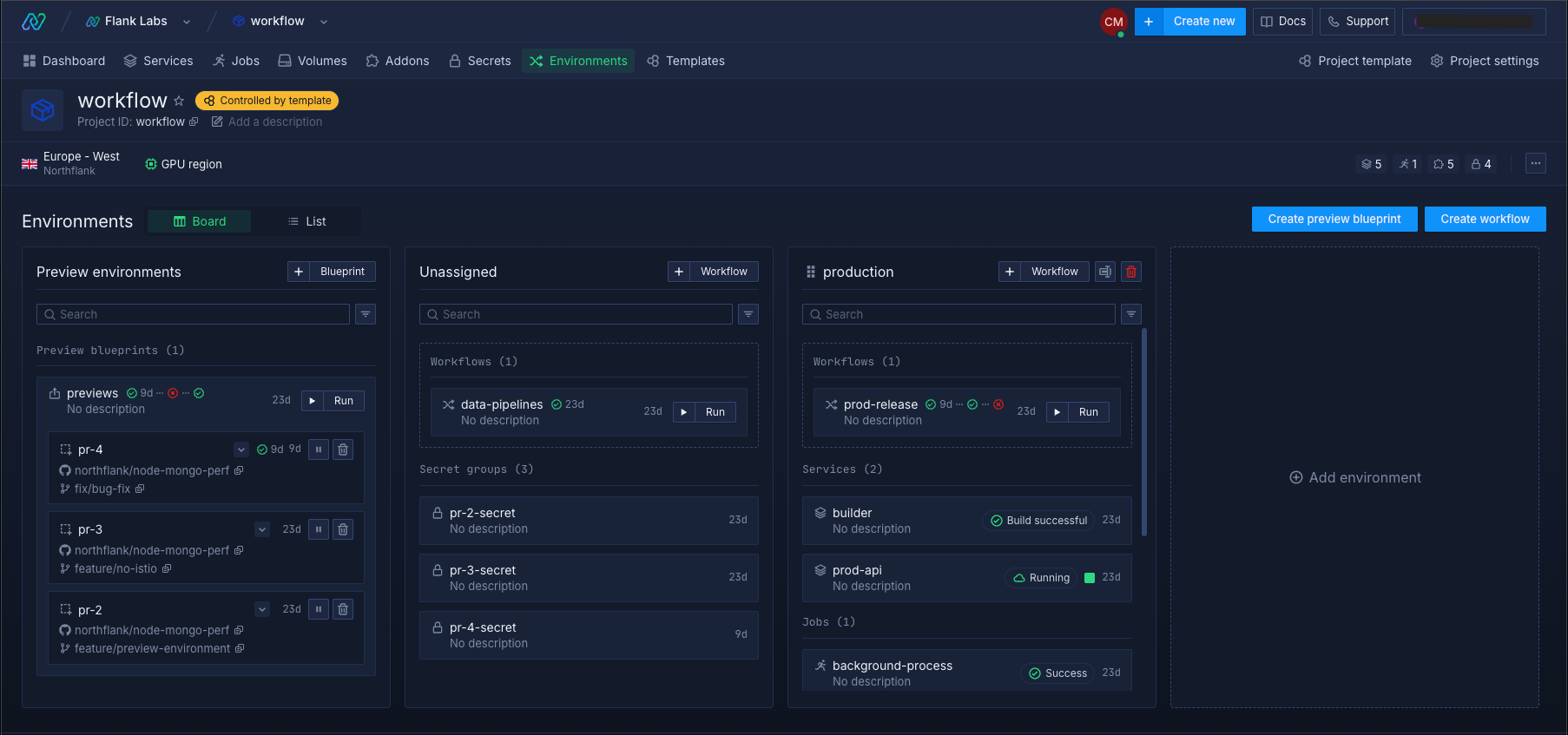
Set up environments
Northflank has introduced a streamlined process for automating software release workflows through its environments feature. The platform now allows users to create isolated preview environments automa…
- Featurenorthflank.com
How to deploy SaaS in a customer VPC: implementation approaches and tradeoffs
Northflank has published a technical guide outlining implementation approaches for deploying SaaS applications within customer VPCs, highlighting the growing enterprise demand for such deployments due…
- Sunsetnorthflank.com
App Runner is in maintenance mode. 9 top AWS App Runner alternatives in 2026
AWS App Runner is now in maintenance mode, limiting its suitability for modern containerized workloads and prompting users to seek alternatives. The platform’s automated scaling, networking, and deplo…
- Featurenorthflank.com
SaaS deployment in customer environments: a guide for SaaS vendors
SaaS vendors are increasingly required to deploy their software within enterprise customers' own cloud environments (AWS, GCP, Azure) rather than in shared vendor infrastructure, driven by compliance …
- Launchnorthflank.com
Top OpenSandbox alternatives for managed AI sandbox infrastructure in 2026
OpenSandbox, an open-source sandbox platform released by Alibaba in March 2026, requires self-hosted infrastructure with no managed hosting, compliance certifications, or BYOC support, limiting its ap…
- northflank.com
Modal vs Vercel Sandbox: comparing AI sandbox environments in 2026
The article compares Modal and Vercel Sandbox, two platforms designed for running untrusted or agent-generated code in isolated environments, with a focus on their suitability for AI workloads in 2026…
- Featurenorthflank.com
Best agent cloud platforms in 2026
The article defines 'agent cloud platforms' as the infrastructure layer enabling AI agents to execute code, maintain state, and scale workloads in the cloud. It highlights a key shift in 2026: the dis…
- northflank.com
Top HopX.ai alternatives for AI sandbox and agent infrastructure in 2026
The article compares top alternatives to HopX.ai, a managed sandbox platform by Bunnyshell, for AI agent infrastructure and code execution in 2026. The most significant change highlighted is the shift…
- northflank.com
E2B vs Vercel Sandbox: comparing AI sandbox environments in 2026
The article compares E2B and Vercel Sandbox, two platforms designed for running AI-generated code in isolated environments, highlighting key differences that impact infrastructure decisions for AI wor…
Northflank 在 2026年4月 发布了 43 项受追踪的更新。 较 2026年3月 下降 17%。 主要主题是 content pieces(14)。 活动主要集中在 2026年4月27日 那一周。 亮点:“Best CI/CD tools in 2026”(2026年4月29日)。
信号分类:2026年4月
14
content pieces
11
feature updates
3
product launches
1
competitive content marketing
1
product sunsets
浏览 Northflank 的其他月份